Appearance
Workflow example
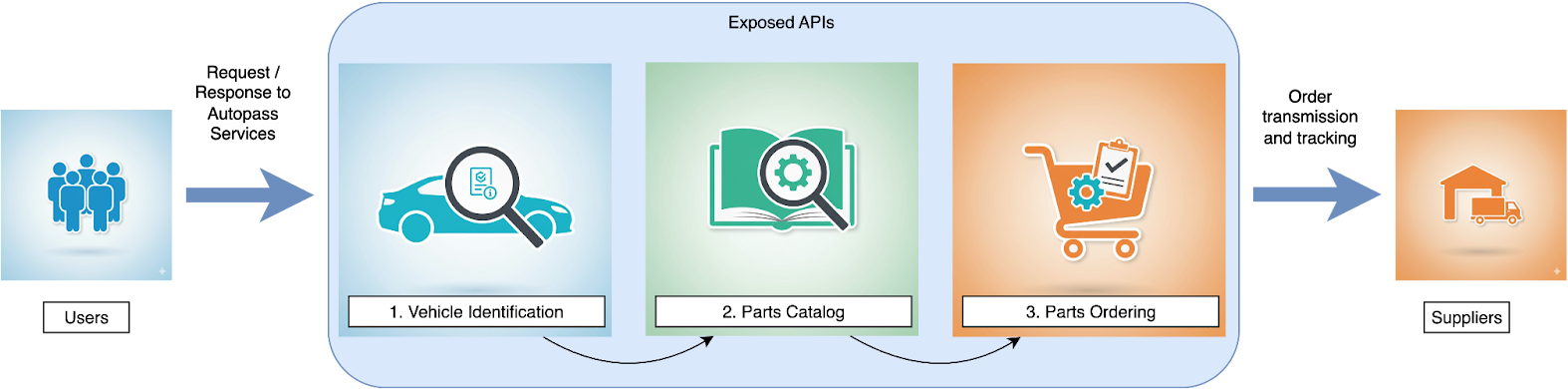
This workflow outlines a flexible, API-driven ecosystem designed to connect clients (such as e-commerce platforms, repair shops, or fleet management software) with a network of parts suppliers.
The system is centered around three core, independently consumable API services:
Vehicle Identification
This service allows clients to accurately identify a specific vehicle, typically using a VIN, registration number, or make/model/year lookup.
Catalogue
This service provide access to a comprehensive catalogue, enabling clients to find compatible parts (assignments) for a previously identified vehicle.
Parts Ordering (E-Procurement)
This service allows clients to place purchase orders for specific parts, then transmits these orders directly to the appropriate suppliers for fulfillment.
A key attribute of this architecture is its flexibility.
Clients are not locked into a linear sequence, they can utilize these services à la carte:
- A client might only use the Vehicle Identification to normalize their own data.
- Another client might use the Vehicle Identification followed by the Catalogue to build a parts list, without placing an order.
- A third client, who already has the necessary vehicle and parts numbers, might interact only with the Parts Ordering (E-Procurement) to manage procurement.
This modular approach allows clients to integrate the specific functions they need, seamlessly connecting them to the supplier network at different points in their own business processes.