Appearance
E-Procurement (HAMP)
E-Procurement seamlessly allows to check availability and place orders with a diverse range of car part distributors.
Availability Request
This is service can be used for knowing if a part is available for an order.
It performs in parallel each av request given in the body within a list.
All the availability responses are returned, attached to their original availability request.
Error messages are to be expected as soon as one of the requests is faulty. In this case, no request is treated. The av requests do not need to be sent to the same provider.
When no provider is specified for an av request, then all the providers the client has access to, and that are relevant with the way the inquired product is described, are requested.
Order Request
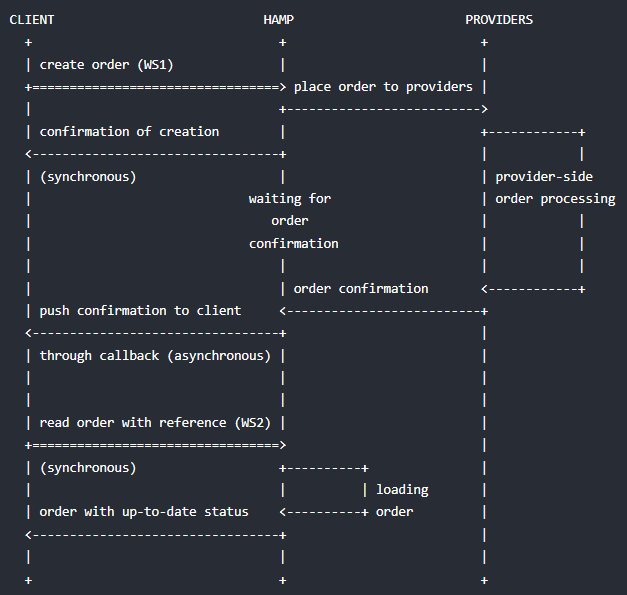
There are 2 web services involved when placing orders with E-Procurement.
The first one consists in pushing a new order to E-Procurement.
This service is asynchronous because it only synchronously responds to the client to indicate if the order has correctly been taken into account by E-Procurement, or if there is an error preventing it.
When no problem is detected, the order that has been initialised within E-Procurement is returned to the client with an E-Procurement order reference.
E-Procurement contacts the car part providers to push the items that are intended for them, and wait for these providers to respond.
Then E-Procurement updates the order and its items.
If the client has a callback service, then E-Procurement can use it to push the order confirmation back to it. Reading an order
When a client does not provide a callback service, then the only way for a client to know if an order is confirmed or cancelled, is to read it with its reference (WS2).
| status | label | description |
|---|---|---|
| 2 | initialised | The order is saved and is going to be forwarded to the targeted providers |
| 3 | confirmed | All the items are confirmed as ordered |
| 5 | partially confirmed | There is at least 1 item that could not be ordered, but some could |
| 7 | canceled | No item could be ordered |
Summary